
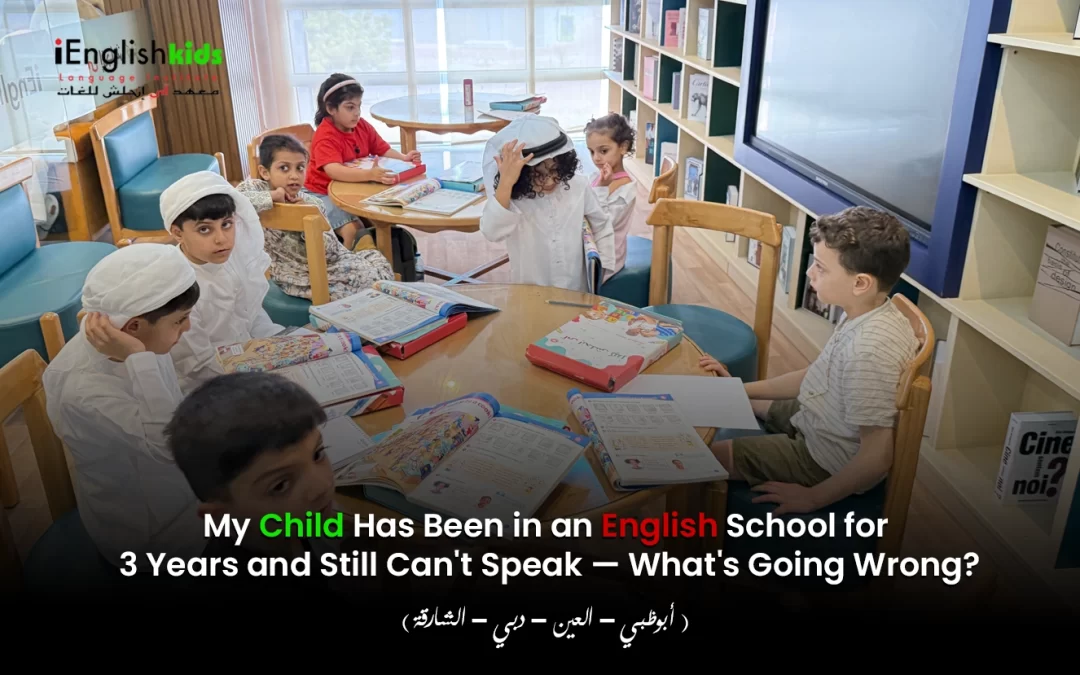
My Child Has Been in an English School
for 3 Years and Still Can’t Speak —
What’s Going Wrong?
You’re not doing anything wrong — but the school might be. Here’s the honest truth every parent in the UAE needs to hear.
01 Why 3 Years of English School Isn’t Enough
Your child can read. They can write. They can pass the exam. But the moment a stranger says “Hello, how are you?” — silence. This is one of the most common frustrations among parents in Dubai, Abu Dhabi, Sharjah, and across the UAE.
And here’s the uncomfortable truth: English schools in the UAE are not designed to produce fluent speakers. They are designed to produce students who pass English exams. These are two very different things.
A child can spend 6 hours a day in an English school for years and still struggle to hold a conversation — because the school spends the majority of that time on grammar worksheets, reading comprehension, and written tests. Actual speaking practice? Often just 15-20 minutes per week in a class of 30 children.
02 The Real Reasons Your Child Still Can’t Speak
Before blaming yourself or your child, understand the actual causes. Most of them have nothing to do with ability or intelligence:
The School Teaches English — Not Speaking
There’s a critical difference. Schools teach the rules of English (grammar, vocabulary, reading). Speaking is a separate skill that requires a different kind of training — one that most schools simply don’t provide enough of.
Arabic Dominates Outside the Classroom
In the UAE, as soon as the school bell rings, most children switch entirely to Arabic — at home, with friends, watching videos, playing games. Language needs daily exposure to stick. Without it, school learning evaporates quickly.
Fear of Making Mistakes in Front of Peers
Children are acutely aware of being judged by classmates. In a class of 30, most children choose silence over the risk of embarrassment. Fear of mistakes is the number one barrier to speaking fluency at any age — and it starts young.
Passive Learning Instead of Active Production
Listening to the teacher, reading from a textbook, watching videos — these are passive activities. Speaking is active production. You can’t learn to ride a bike by watching someone else ride it. The same applies to language.
No Real-Life Context
School English is abstract — “write a paragraph about your holiday.” But real speaking happens in context: at a restaurant, in a job interview, with a friend. Without contextual, real-life practice, children can’t transfer classroom knowledge to actual conversation.
Large Class Sizes Leave No Room for Practice
In a class of 30 students with a 45-minute lesson, each child gets approximately 90 seconds of speaking time. That’s not a program for fluency — that’s a program for silence. Small groups are non-negotiable for real speaking development.
03 What Schools Teach vs. What Speaking Actually Requires
Grammar rules, written exams, reading comprehension, spelling, vocabulary lists — measured by test scores
Real-time speaking practice, immediate feedback, confidence building, contextual conversations, and consistent daily exposure
“If a child studies English for enough years, they’ll naturally start speaking” — this is simply not how language acquisition works
Speaking fluency is a separate skill that must be specifically trained. A child who knows 2,000 words but never practices speaking will remain silent
“My child must be slow with languages — they’ve been in school for years and still can’t speak”
Your child almost certainly has the vocabulary and knowledge — they just need the right environment to unlock it. Most children improve dramatically within weeks of proper speaking practice
04 What Actually Works: The Proven Approach
After 17 years working with children across Dubai, Abu Dhabi, Sharjah, Al Ain, and Fujairah, here’s what consistently produces speaking fluency in children:
05 What Parents in the UAE Can Do Right Now
You don’t have to wait for school to fix itself. Here’s what you can start today:
- ✓Create an English time at home — even 20 minutes daily. This doesn’t mean homework. It means dinner conversation in English, an English cartoon, or a bedtime story in English. Consistency beats intensity.
- ✓Stop correcting every mistake. When you correct your child mid-sentence, they learn to stay silent to avoid correction. Let them finish, celebrate the attempt, then model the correct version naturally.
- ✓Enroll in a speaking-focused supplementary program. School alone won’t do it. A dedicated speaking program like iEnglish Kids provides what school can’t: focused practice, small groups, and immediate feedback.
- ✓Make English fun, not a subject. English YouTube channels about topics your child loves, English video games, English music — when it’s connected to what they enjoy, resistance drops dramatically.
- ✓Be patient with the silent period. Children often go through a “silent period” before they start speaking — absorbing language before producing it. This is normal. The key is to keep the input coming consistently.
- ✓Find English-speaking friends or groups. In Dubai and across the UAE, international playgroups and activity clubs provide natural speaking environments. Peer interaction is one of the most powerful motivators for children.
06 Real Stories from UAE Parents
My son was in an English school in Dubai for 4 years. He could write essays but froze completely when anyone spoke to him in English. After 10 weeks at iEnglish, he was chatting with his teacher’s foreign colleagues at the school open day. I couldn’t believe it.
We live in Fujairah and I was worried there wouldn’t be good options here. The iEnglish branch exceeded all my expectations. My daughter went from refusing to speak English to correcting MY English at home within two months. The small group made all the difference.
I was skeptical — my son had been in an English school since KG1 and still couldn’t hold a conversation. The teacher at iEnglish explained exactly why that happens and what they do differently. Three months in, he’s arguing with me in English. I’ll call that a win.
07 Frequently Asked Questions
Ready to Help Your Child Finally
Speak English with Confidence?
Book a free assessment for your child at your nearest iEnglish branch. Our specialists will identify exactly what’s holding them back and design a personalized speaking program — available in Dubai, Abu Dhabi, Sharjah, Al Ain, and Fujairah.