
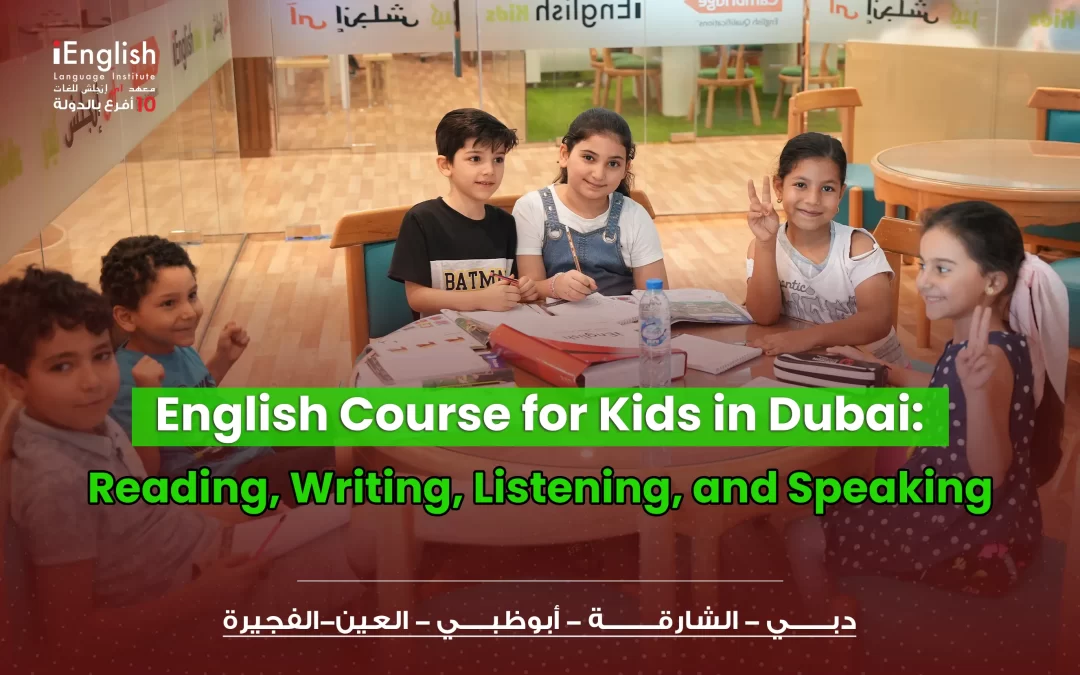
English Course for Kids
in Dubai
The four skills that build real English — not just test scores. Discover how iEnglish develops every language skill in children aged 4 to 17 across the UAE.
01 Why All Four Skills Matter — Not Just Grammar
Most English programs in Dubai teach children how English works. The best ones teach children how to use it. There’s a critical difference — and it shows the moment your child is put in a real-life English situation.
Language has four interconnected skills: reading, writing, listening, and speaking. They reinforce each other. A child who reads English regularly develops a larger vocabulary for writing. A child who listens actively absorbs pronunciation for speaking. A child who speaks daily builds the confidence to write more freely.
The problem with many English courses for children in Dubai is that they over-emphasize reading and writing (passive skills) because those are easier to test — while underdeveloping listening and speaking (active production skills) which are what children actually need in the real world.
02 Skill 1 — Reading: Building the Foundation
Reading in English is not just decoding letters — it’s understanding meaning, context, and inference. For children in Dubai, English reading development follows a natural progression that iEnglish programs are carefully designed around:
Ages 4-6 (Phonics Stage): Children learn the sounds letters make before they learn the names of letters. Phonics-based instruction — songs, rhymes, letter-sound games — creates the foundation that everything else builds on.
Ages 7-10 (Fluency Stage): Children move from decoding words to reading for meaning. They read short stories, answer comprehension questions, and begin to read faster and more naturally. Vocabulary expands rapidly at this stage.
Ages 11+ (Analysis Stage): Students read longer texts, identify themes, make inferences, and compare texts. This is the reading level required for school examinations and, eventually, IELTS and EmSAT.
Activities to build reading at home
03 Skill 2 — Writing: Finding Their Voice
Writing is where children learn to organize thoughts, choose words precisely, and express themselves in a way that others can understand without seeing their face or hearing their tone. It’s a skill that separates children who “know English” from those who can communicate in English.
Ages 4-6: Letter formation, writing their name, tracing words — building the physical and conceptual habit of putting English on paper.
Ages 7-9: Simple sentences, short paragraphs about familiar topics (my family, my pet, my favourite food), and creative captions for pictures.
Ages 10-12: Structured paragraphs, beginning to use connectives, planning before writing. This stage builds the academic writing foundation for secondary school.
Ages 13+: Essay planning, argument writing, narrative composition, and professional writing basics — the skills that determine performance in school examinations.
04 Skill 3 — Listening: The Most Underrated Skill
Listening is the first language skill a child develops — and it’s the one most English programs in Dubai neglect. Yet without strong listening skills, a child cannot follow classroom instructions, understand teachers, or participate in real English conversations.
Listening in English for children in Dubai is particularly important because they encounter multiple accents daily — British, American, Australian, South Asian, Arab — each with different rhythms, speeds, and pronunciations. Learning to hear English in all its forms is a skill that pays dividends throughout school and life.
At iEnglish, listening is integrated into every session through teacher instructions, pair activities, audio exercises, and storytelling — not as a separate “listening test” but as a natural part of every English interaction.
05 Skill 4 — Speaking: The Skill That Changes Everything
Speaking is the skill that makes everything visible. A child can read, write, and understand English perfectly — but if they can’t speak confidently, none of the other skills will help them in a school interview, a classroom discussion, or life in Dubai’s international environment.
Fear of speaking is the single biggest barrier to English fluency in children in the UAE. Children who fear making mistakes in front of peers go silent. Silence prevents practice. No practice means no progress. This is the cycle iEnglish is specifically designed to break.
Our maximum-8-children-per-class rule exists precisely because of speaking: in a class of 30, each child speaks for 90 seconds per session. In a class of 8, they speak for 15-20 minutes. That difference is everything.
06 Age-Specific Programs at iEnglish Dubai
Children at different ages learn language in fundamentally different ways. Here’s how iEnglish structures programs around this reality:
07 What Makes iEnglish Different for Kids in Dubai
08 How to Support Your Child at Home
The families whose children progress fastest all share one thing: they make English part of normal daily life, not a separate study subject. Here’s how:
- ✓20 minutes of English daily — but make it enjoyable. A book, a show, a game, a conversation. The format matters less than the consistency. Daily enjoyable exposure beats weekly intense drilling every time.
- ✓Ask about their day in English at dinner. One question. Let them answer as much or as little as they want. The habit of speaking English naturally at home is more valuable than any exercise book.
- ✓Read with them in English — even just 5 minutes. You don’t need to be fluent in English to read a picture book together. The shared experience matters as much as the language itself.
- ✓Never correct anxiously. When your child makes a mistake, model the correct version naturally: “Oh, you mean ‘I went to school’ — yes, tell me more about that!” Never “No, that’s wrong, say it again.”
- ✓Change the language on their favourite apps and games. If they love a game, switching it to English doesn’t feel like studying — it feels like playing. The motivation is already there.
- ✓Use the iEnglish app for 10 minutes after each class. The app exercises are designed to reinforce what was covered in class. Doing them within 24 hours of a session dramatically improves retention.
09 Dubai vs. Other UAE Emirates — What’s the Difference?
| Emirate | English Environment | Best For | iEnglish Branch |
|---|---|---|---|
| Dubai | Maximum international exposure daily | Full 4-skills immersion, school admission prep | ✓ 2 branches |
| Sharjah | Strong academic culture | Reading, writing, school preparation | ✓ Yes |
| Abu Dhabi | Government & professional sectors | All skills + professional communication | ✓ Yes |
| Al Ain | Healthcare & education focused | All four skills, school admission | ✓ Yes |
| Fujairah | Tourism & ports growing | Four skills + speaking confidence | ✓ Yes |
10 What Parents Say
My 7-year-old went from refusing to speak English to reading bedtime stories to her younger sister. The four-skills approach at iEnglish Dubai made everything connect — she didn’t just improve in class, she started using English in real life.
My son’s reading comprehension went from below-average in school to top of his class. But the biggest change was his speaking — he used to freeze in class discussions. Now he volunteers to answer. The small group changed his confidence entirely.
My twin daughters (9 years old) joined iEnglish Sharjah. The monthly reports told me exactly what each one needed to work on — one was strong in reading but weak in speaking, the other the reverse. Targeted, specific, and it worked.
11 Frequently Asked Questions
Give Your Child the Gift of
Real English Confidence
Book a free placement assessment for your child at your nearest iEnglish branch. Our specialists will identify their current level across all four skills and design a program specific to their age and goals.