
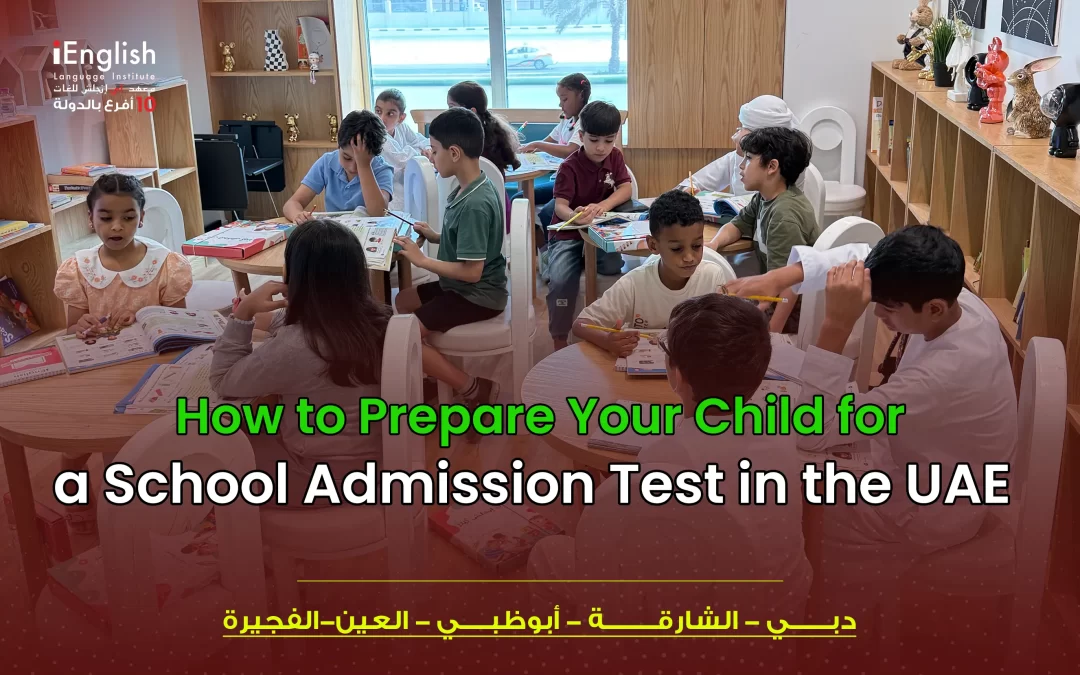
How to Prepare Your Child for a
School Admission Test in the UAE
Admission season in the UAE is competitive. The English assessment component is usually what separates the children who get in from those who don’t — and it’s the one area parents can most directly influence.
What UAE School Admission Tests Actually Cover
Most parents are surprised by what’s actually assessed — and what isn’t. UAE school admission tests are not comprehensive academic exams. They’re designed to gauge whether a child is ready to learn effectively in that school’s environment.
Why the English Component Is Usually Decisive
In Dubai, Abu Dhabi, Sharjah, and across the UAE, most sought-after private schools teach in English. The admission test is, at its core, an assessment of whether your child can function in an English-language classroom.
A child who struggles to understand instructions in English, who can’t respond to simple questions, or who becomes visibly anxious when addressed by an English-speaking assessor — will struggle in the classroom. Schools know this. It’s why the spoken English interaction often carries more weight than the written paper.
- Willingness to speak and try
- Ability to follow simple instructions
- Age-appropriate vocabulary range
- Confidence when answering questions
- Basic sentence construction ability
- Active listening and eye contact
- Complete silence when spoken to in English
- Inability to understand basic instructions
- Extreme anxiety or distress during assessment
- No foundational vocabulary for the entry level
- Relying entirely on a parent to translate
- No exposure to English at all before the test
What to Expect at Each Stage
The content and style of admission assessments changes significantly with age. Here’s what’s typically assessed at each major entry point:
| Entry Level | Age | English Component | Key Skill Assessed |
|---|---|---|---|
| KG1 / Foundation | 4–5 yrs | Oral interaction, following instructions | Readiness to participate in English |
| Year 1 / Grade 1 | 5–6 yrs | Simple reading, listening, speaking | Basic phonics and verbal response |
| Years 2–4 | 6–9 yrs | Reading, writing, comprehension, conversation | Sentence-level reading and writing |
| Years 5–7 | 9–12 yrs | Paragraph writing, spoken response, comprehension | Independent expression in English |
| Secondary Entry | 11–14 yrs | Essay writing, reading analysis, interview | Academic English proficiency |
The 6-Month Preparation Plan That Works
Cramming the month before doesn’t build genuine skill. Here’s what a realistic, effective preparation timeline looks like:
What Parents Should Do — and Stop Doing
- ✓Speak English with your child for at least 20 minutes daily — even imperfectly. Children mirror parental attitudes toward language. If you treat English as normal and pleasant, they will too.
- ✓Watch English content together. Age-appropriate shows in English (with English subtitles, not Arabic) build natural comprehension and vocabulary without feeling like study.
- ✓Ask your child questions about their day in English. Simple, warm conversation at home creates speaking confidence that transfers directly to the assessment.
- ✓Normalize mistakes. Never laugh at or correct anxiously when your child makes a mistake in English. Say: “Great try — another way to say that is…” Children who fear mistakes become silent. Silence fails admissions.
- ✗Don’t create a “test anxiety” atmosphere. Children who are constantly reminded that “this test is very important” and “you must pass” perform worse. Stress physically impairs language recall.
- ✗Don’t cram vocabulary lists. Memorized word lists that aren’t connected to context evaporate under pressure. Real vocabulary is built through conversation and stories, not flashcard drilling.
- ✗Don’t compare your child to other children. Every child develops language at a different pace. Comparison creates anxiety that directly undermines the confidence you’re trying to build.
How iEnglish Prepares Children for Admission Tests
Many parents enroll their children at iEnglish specifically for school admission preparation. Here’s what the program provides that directly maps to what admission tests assess:
- ✓Small groups (max 8-10 children) ensure every child speaks in every session — not 90 seconds per class in a group of 30. Speaking practice is the primary activity, not a side element.
- ✓CELTA-certified teachers who specialize in children know how to build confidence alongside skill. They create environments where children try without fear — the same environment they need to recreate in the admission room.
- ✓Age-specific curricula mean your child is learning exactly the vocabulary and skills assessed at their entry level — not a generic course that may be too advanced or too basic.
- ✓Monthly progress reports tell you precisely what your child has mastered and what needs more work — so you can support at home in a targeted way.
- ✓The iEnglish app extends practice beyond class sessions with games and audio exercises your child will actually want to use — building the daily English habit that makes the real difference.
- ✓Admission-specific preparation is available on request — talk to the branch about your child’s target school and timeline. Programs can be adjusted to prioritize the skills most relevant to your specific admission process.
The Week Before the Test — A Practical Checklist
- ✓Visit the school building with your child if possible. Familiar environments reduce anxiety enormously. Even driving past and pointing it out helps.
- ✓Talk through what will happen — in a calm, positive way. “You’ll meet a nice teacher who wants to chat with you. They’ll ask you some things about yourself and maybe ask you to read a bit.”
- ✓Practice one or two simple questions like “What’s your name?” and “What do you like?” — just to warm up the habit, not to script every answer.
- ✓Ensure they sleep well the two nights before. Tired children’s language recall drops significantly. Sleep is more valuable than any last-minute practice.
- ✓Feed them a good breakfast on test day. This is not a small thing — hunger affects cognitive performance meaningfully in children.
- ✗Don’t review English material the night before. The brain consolidates during sleep — new information the night before a test interferes with consolidation of what’s already there.
- ✗Don’t talk about the test constantly. Treat it as one ordinary event in an ordinary day. Your calm is directly contagious to your child.
Real Parents, Real Results
My daughter was 6 when we started at iEnglish Dubai to prepare her for the GEMS school admission test. She couldn’t string a full sentence in English. After 4 months, she walked into that assessment room and had a full conversation with the examiner. She got in. Her teacher told me confidence was the reason.
We were told our son failed the Year 4 admission test for a British curriculum school because he “didn’t engage verbally.” We enrolled him at iEnglish Sharjah. Six months later, same school, same test — he passed. The difference was entirely his willingness to speak. The small group made him feel safe enough to try.
My twins (8 years old) needed to enter an Abu Dhabi international school. I started preparation 5 months out at iEnglish Abu Dhabi. The monthly reports told me exactly what each child needed to work on — one needed vocabulary, the other needed confidence. Targeted. Both passed. Worth every dirham.
My son is 12 and we live in Al Ain. He was preparing for secondary school admission at an international school. The iEnglish Al Ain program focused on exactly the academic English the test required — essay planning, reading comprehension, and interview practice. He passed on first attempt. The teacher knew the test format well.
prepare child school admission test UAE school admission English test Dubai UAE school entry test preparation child English test preparation Abu Dhabi school admission test Sharjah private school entrance exam UAE iEnglish kids school preparation English test for school admission Dubai how to prepare child school UAE school admission Al Ain Fujairah
Frequently Asked Questions
Give Your Child the Confidence
to Walk In and Win
Book a free placement assessment for your child at your nearest iEnglish branch. Our specialists will identify their current level and design a preparation plan specific to their target school and entry year.